Table of Contents
Last Updated: September 26, 2026
Why Balance Matters More Than Blade Steel
Custom balanced chef knives are kitchen tools whose weight is deliberately distributed to match the hand and cutting style of the person using them, rather than the average of a factory production line. At GS Custom Knives, we build every blade around a single principle: where the weight sits matters more than how exotic the steel sounds on a spec sheet.
Here's what most knife buyers get wrong. They spend hours comparing steel types and ignore the balance point entirely, then wonder why a knife that arrived razor-sharp leaves their wrist aching after twenty minutes of prep. A blade with poor weight distribution forces your hand to fight gravity on every stroke. A well-balanced one lets the knife do the work.
That difference shows up in three places: how long you can cut without fatigue, how precisely you control the tip, and how consistently the edge meets the board. Steel determines how long an edge lasts. Balance determines whether you actually enjoy using the knife.
Key Takeaway
Balance is the one property you feel on every single cut. Steel quality only shows up when the edge dulls.
Ergonomic Kitchen Knife Design: How Biomechanics Reduce Chef Fatigue
Ergonomic kitchen knife design is the practice of shaping the blade, bolster, and handle so the hand and wrist stay in a neutral position through repetitive cutting motions. When the tool fits the hand, the forearm muscles stop compensating, and chef fatigue drops dramatically over a long prep session.
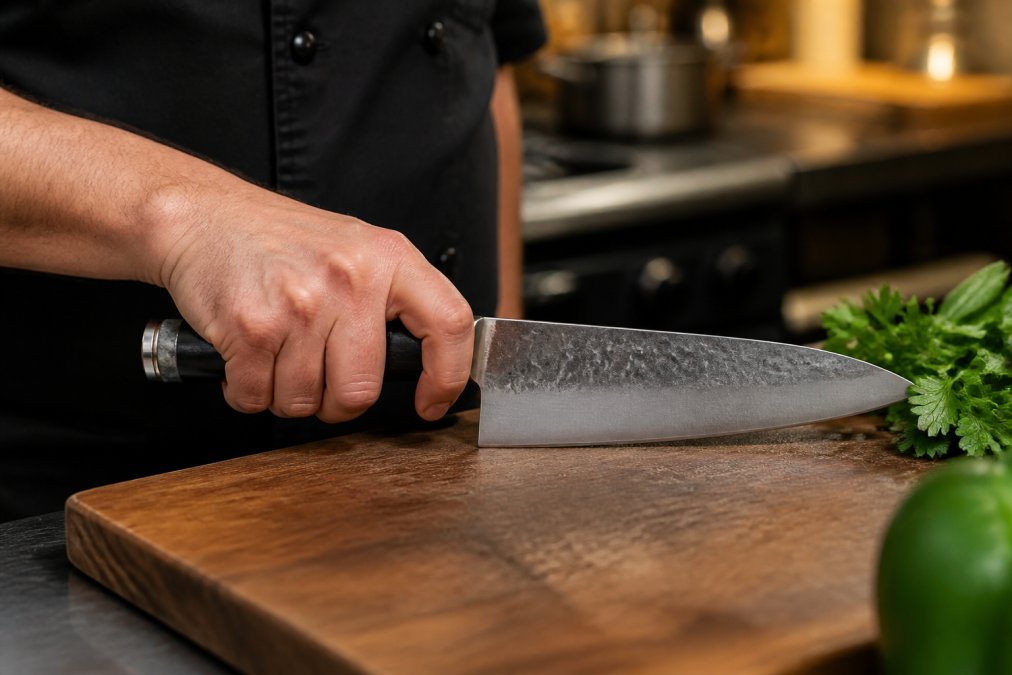 Close-up of a chef's hand gripping a custom chef knife on a wooden cutting board, showing relaxed wrist position and natural finger placement
The biomechanics are straightforward.
Three design choices drive this:
-
Handle circumference sized to your palm so your fingers wrap without squeezing
-
Spine and choil rounding so no hard edge digs into your index finger
-
Balance point placed at or just ahead of the pinch grip for controlled rocking cuts
Hand-Forged vs Factory Kitchen Knives: Where the Real Differences Show
Hand-forged vs factory kitchen knives is less about romance and more about how much material the maker can remove, adjust, and tune after the initial shape is formed. A forged blade is hammered and ground to a specific profile for a specific user. A stamped blade is punched from a sheet of steel and finished to a uniform standard.
That distinction produces four practical differences:
| Factor |
Hand-Forged Custom |
Factory Stamped |
| Balance point |
Set to your grip |
Fixed for average hand |
| Distal taper |
Ground progressively toward the tip |
Often minimal or uniform |
| Handle fit |
Sized to your palm |
One of a few stock sizes |
| Edge geometry |
Tuned to your cutting style |
Compromise profile |
How to Test Knife Balance Before You Commit
Learning how to test knife balance takes about thirty seconds and one finger. Lay the blade flat across your index finger and slide it until the knife levels out. That spot is the balance point. Mark it mentally, then check where it sits relative to the bolster.
Here's the practical interpretation:
-
Balance at the bolster: neutral, good for general prep and slicing
-
Balance 1-2 cm ahead of the bolster: ideal for rocking cuts and chef-style work
-
Balance well forward on the blade: suited to chopping and heavier tasks
-
Balance behind the bolster: handle-heavy, tiring for long sessions
Pro Tip
Test balance with the knife dry and your hand relaxed. A nervous, tight grip masks poor balance because your muscles compensate without you noticing.
The Customization Process: Built Around Your Hand, Not a Mold
The customization process starts with measurements, not aesthetics. Before any steel is cut, we capture hand length, palm width, grip style, and the cutting tasks the knife will actually face. A hunter breaking down game needs a different balance point than a home cook dicing onions.
What We Actually Measure
Most buyers assume "custom" means choosing a handle wood and a blade length. In practice, four numbers drive the build:
Add →
-
Palm width (across the knuckles, in inches) sets handle circumference. A handle that's too thick forces a loose grip; too thin and the fingers curl into a fist, which tires the forearm.
-
Hand length (wrist crease to middle fingertip) sets handle length and where the balance point should sit relative to your pinch grip.
-
Grip style, pinch, hammer, or a hybrid, determines whether the balance point lands at the bolster or 1-2 cm ahead of it.
-
Dominant cutting motion, rocking, push-cut, or chop, sets the belly curve and edge geometry.
The Collaborative Loop
A custom build is a back-and-forth, not a form submission. The stages look like this:
-
Consultation: blade shape, length, intended use, and any current pain points (wrist fatigue, hot spots, slipping grip).
-
Handle selection: material, contour, and finish, stabilized wood, synthetic composite, or a hybrid, chosen for how it behaves in a wet kitchen, not just how it looks.
-
Balance targeting: weight distribution set to your grip and cutting motion, confirmed against your measurements.
-
Grinding and profiling: edge geometry matched to your cutting style, with distal taper ground progressively toward the tip.
-
Fit check and final sharpening: the knife is tested in hand before it ships, and adjustments are made while the blade is still on the bench.
Why This Can't Be Replicated at Scale
Mass-market premium knives are built around an average hand, usually a size medium, sized for a demographic rather than a person. Their tooling is amortized across thousands of units, so every deviation from the average is a cost they can't absorb. A custom build has no average to hit. The result is a blade that fits a hand, not a demographic.
Pro Tip
Measure your palm width before your first consultation. It takes thirty seconds with a tape measure across the knuckles and gives the maker a concrete starting point instead of a guess.
Long-Term ROI: What a Custom Balanced Chef Knife Actually Costs You
The long-term ROI of custom balanced chef knives comes down to replacement cycles and edge retention, not the sticker price. A knife that holds an edge longer and doesn't need replacing every few years costs less per year of use than a cheaper blade you rebuy repeatedly.
The Cost-Per-Use Framework
Cost per use = (purchase price + maintenance costs over the period) ÷ total uses in the period
Replacement Cycles Are the Hidden Cost
A custom blade with geometry matched to your cutting style and a grind profile that leaves room for decades of sharpening can stay in service far longer. The steel doesn't have to be exotic, it has to be heat-treated correctly and ground so the edge can be maintained rather than consumed.
What Actually Drives the Price
Pricing for a custom build depends on blade shape, handle material, and finishing work, so we quote each project individually rather than publishing a flat rate. The variables that move the number most are:
-
Steel and heat treatment, the foundation of edge retention
-
Handle material, stabilized wood and synthetic composites cost more than basic scales but resist moisture and swelling over years
-
Grind complexity, a full distal taper and tuned edge geometry take more bench time than a uniform grind
-
Finish work, spine and choil rounding, hand-sanded contours, and final sharpening
Watch Out
Don't judge a custom knife by purchase price alone. A blade with poor edge retention that you replace every two years often costs more over a decade than one well-built knife you maintain properly. The comparison only works when you count the replacements you didn't have to buy.
Key Takeaway
The investment case for a custom balanced chef knife isn't the sticker price. It's the number of times you don't have to buy the knife again.
Maintenance, Edge Retention, and the Lifetime Guarantee
Edge retention is the measure of how long a knife keeps a working edge under normal use. It depends on steel hardness, grind profile, and how you treat the blade between sharpenings. High-carbon steel and properly heat-treated stainless both hold an edge well when the geometry is right.
Maintenance is simple if you stay consistent:
- Hone lightly before each session to realign the edge
- Sharpen at a consistent angle matched to your grind profile
- Hand wash and dry immediately; never leave a blade soaking
- Store on a magnetic strip or in a saya to protect the edge
Frequently Asked Questions
Are custom balanced chef knives worth the money?
For anyone who cooks daily, the math often works out. Factory knives at big-box stores typically last a few years before the edge degrades or the handle loosens. A custom balanced chef knife built from high-carbon steel with a full tang and matched grind profile can hold its edge far longer between sharpenings, and the ergonomic grip reduces wrist strain over hundreds of hours of use. Pricing depends on blade steel, handle material, and customization level, so check GS Custom Knives for current options.
What specific features define a perfectly balanced chef knife?
Balance point location is the main one. A well-balanced chef knife sits right at the bolster or just forward of it, so the blade does the work instead of your wrist. Other markers include a full tang that runs the length of the handle, a distal taper that thins the blade toward the tip for precision cutting, and a handle shaped to your grip. Weight distribution, blade thickness, and grind profile all affect how the knife feels in motion.
What are the primary differences between hand-forged and factory kitchen knives?
Hand-forged blades are shaped by a maker who controls the grind profile, distal taper, and heat treatment individually. Factory knives are stamped or laser-cut from sheet steel and sharpened on automated lines. That means a hand-forged blade can be tuned to your hand size, cutting style, and preferred balance point. Factory knives are consistent but generic. The trade-off is time and cost, since custom craftsmanship takes weeks rather than minutes.
Do custom chef knives require different maintenance than standard knives?
The fundamentals are the same: hand wash, dry immediately, hone regularly, and sharpen at the correct angle. High-carbon steel can patina over time, which is normal and not rust. Damascus steel needs a light coat of food-safe oil if stored long-term. The difference is that a custom knife's edge geometry is set for your cutting style, so honing with a ceramic rod every few uses keeps that edge retention working in your favor.