Table of Contents
-
Start With the Job: Matching Custom Hunting Knife Steel to Game Size
-
Carbon Steel vs Stainless Steel for Knives: What Changes in the Field
-
The Four Properties That Decide Everything: Hardness, Toughness, Wear Resistance, and Corrosion Resistance
- Blade Geometry, Grind Profile, and Spine Thickness: The Specs That Shape Steel Performance
- Best Steel for Custom Fillet Knives: Flexibility, Corrosion Resistance, and a Thin Edge
- How to Maintain a Custom Hunting Knife Edge: Honing, Stropping, and Rust Prevention
- Conclusion: Build the Knife Around the Hunt, Not the Spec Sheet
- Frequently Asked Questions
Last Updated: October 4, 2026
Start With the Job: Matching Custom Hunting Knife Steel to Game Size
Knowing how to choose custom hunting knife steel starts with one question: what are you cutting? At GS Custom Knives, we build every blade around the animal it will dress, because steel that shines on a whitetail can fail badly on an elk shoulder. According to industry data on hunting participation from the U.S. Fish & Wildlife Service, millions of hunters head into the field each season, and the demands they place on a blade vary enormously by species.
A knife that quartered a moose may be overkill for bluegill. Match the steel to the job, and geometry, grind, and maintenance fall into place.
Small Game, Birds, and Fish: Thin Edges and Fine Points
Small game rewards finesse, not mass. Squirrels, rabbits, upland birds, and panfish call for a thin edge and a fine point that slips under skin without tearing it. A low-alloy carbon steel at higher hardness takes a keener edge than a thick, wear-resistant blade and touches up in seconds on a pocket stone. Corrosion resistance matters less because you dry the blade the same day.
Deer, Elk, and Hogs: The Middle Ground Most Hunters Need
Medium and large game is where steel choice gets interesting. You need an edge that survives hide, sinew, and joint work without micro-chipping, plus enough toughness for bone contact. Push hardness for edge retention and you invite chipping; drop it for toughness and you sharpen more often. A balanced carbon or stainless steel in the mid-hardness range, paired with sound geometry, covers most deer, elk, and hog work.
Carbon Steel vs Stainless Steel for Knives: What Changes in the Field
The carbon steel vs stainless steel for knives debate comes down to corrosion resistance and sharpenability. Carbon steel takes a finer edge and sharpens easily, but rusts unless you dry and oil it after every use.
The dividing line is chromium content. Steel with roughly 13% or more chromium is classified as stainless, because that chromium forms a passive oxide layer that resists rust.
It helps to name actual grades, because "carbon" and "stainless" are families, not specifications:
-
Simple carbon steels such as 1095 and 1084 are inexpensive, take a very keen edge, and touch up on almost any stone. With essentially no chromium, they rust fast in a damp sheath, so they suit a hunter who cleans and oils the blade the same day.
-
Low-alloy and tool carbon steels such as O1 and 52100 add wear resistance and toughness while staying easy to sharpen, but still require diligent drying and oiling.
-
Mid-range stainless steels such as 154CM, ATS-34, and VG-10 balance edge retention with real corrosion resistance and stay sharpenable on standard stones, suiting hunters who want stainless behavior without a premium price.
-
High-vanadium stainless steels such as S30V, S35VN, and S90V push wear and corrosion resistance higher at the cost of sharpenability, rewarding diamond or CBN abrasives and punishing a lazy touch-up routine.
-
Modern powder metallurgy stainless steels such as CPM MagnaCut and CPM Cru-Wear sit at the top of the field for balancing toughness, edge retention, and corrosion resistance in one alloy, which is why many custom makers have shifted their standard recommendations.
For field use, we generally steer hunters toward carbon steel when they will maintain the blade diligently, and stainless when the knife will sit in a wet pack for days. Neither choice is wrong.
Watch Out
The most common field failure we see is rust, not dullness. A carbon blade left in a damp sheath overnight can pit by morning. Dry it, oil it, and store it dry.
Most guides mention powder metallurgy (PM) steels without explaining why they perform differently. In conventional steelmaking, the alloy is melted and cast, and as it cools, carbides and alloying elements segregate into uneven clusters where cracks start and a fine edge breaks down.
PM steelmaking sidesteps that: the molten alloy is atomized into a fine spray that solidifies into powder particles, then consolidated under heat and pressure.
That is why a modern PM stainless can hold an edge like an old high-vanadium steel while resisting rust and surviving bone contact better than a simple carbon or conventional stainless of similar hardness.
The Four Properties That Decide Everything: Hardness, Toughness, Wear Resistance, and Corrosion Resistance
Four properties decide how a hunting knife performs: hardness, toughness, wear resistance, and corrosion resistance. Hardness, measured on the Rockwell C scale (HRC), governs how long an edge resists deformation; toughness governs whether it chips or rolls under impact; wear resistance determines how slowly the edge abrades; corrosion resistance determines whether the blade survives moisture.
 Custom Damascus hunting knives
Bushcraft With Ste Outdoors
Concrete ranges help. Most hunting knives land between about 56 and 62 HRC. Simple carbon steel like 1095 is often run around 57 to 59 HRC, keeping it tough and easy to sharpen. Mid-range stainless like 154CM typically runs 58 to 60 HRC.
Edge Retention and Wear Resistance: How Long the Edge Lasts
Edge retention is how long a blade keeps a working edge before it needs attention. Wear resistance, driven by carbide-forming elements like vanadium, molybdenum, tungsten, and niobium, extends that interval, which is exactly what you want when dressing multiple animals in one trip. The cost is sharpenability: the same carbides that resist wear also resist your stone.
Steel choice and sharpening equipment should be decided together:
Custom Damascus hunting knives →
-
Simple carbon steels (1095, 1084): touch up on almost anything, including a soft Arkansas stone, ceramic rod, or pocket diamond hone.
-
Low-alloy and tool steels (O1, 52100): friendly to standard stones, though a fine ceramic or medium diamond stone speeds things up.
-
Mid-range stainless (154CM, ATS-34, VG-10): a medium diamond or quality ceramic stone handles these; soft stones struggle.
-
High-vanadium stainless (S30V, S35VN, S90V): diamond or CBN abrasives are effectively required; ceramic works but is slow.
-
Modern PM steels (CPM MagnaCut, CPM Cru-Wear): diamond or CBN is the practical standard, and a strop loaded with diamond compound becomes part of the routine.
If you do not own diamond or CBN abrasives and will not buy them, a high-vanadium or PM steel will frustrate you no matter how good the alloy is. Match the steel to the sharpening kit you will actually maintain.
Toughness, Micro-Chipping, and Edge Rolling: Why Harder Is Not Always Better
Toughness is a blade's ability to absorb impact without failing. When a hard, brittle edge meets bone or a misjudged cut, it fails by micro-chipping, where tiny fragments break off, or edge rolling, where the edge bends instead of fracturing. Both ruin cutting performance.
Heat treatment transparency matters, and it is the question most hunters never think to ask. Two blades can share identical steel, hardness, and geometry yet perform differently because of how they were heat treated. The variables that matter most are:
-
Austenitizing temperature and soak time: how hot the steel was taken and how long it was held, which sets how much alloy dissolves into solution.
-
Quench method: oil, air, or plate quenching, which controls cooling speed and how much martensite forms.
-
Tempering: the temperature and number of cycles, which trade some hardness for toughness and relieve internal stress.
-
Cryogenic treatment: cooling the blade to very low temperatures, often with liquid nitrogen, before tempering. This converts retained austenite to martensite and refines the microstructure, improving wear resistance and dimensional stability.
When you talk to a custom maker, ask directly: what hardness did you target for this steel, how many tempering cycles did you run, and did you cryogenically treat it? A maker who answers in specifics runs a controlled process; one who cannot is guessing, and you are paying for the guess.
Steel is only half the story. Blade geometry, grind profile, and spine thickness determine how that steel actually cuts. A full flat grind thins the blade gradually for slicing efficiency; a hollow grind creates a thin, keen edge but leaves less metal behind it for support.
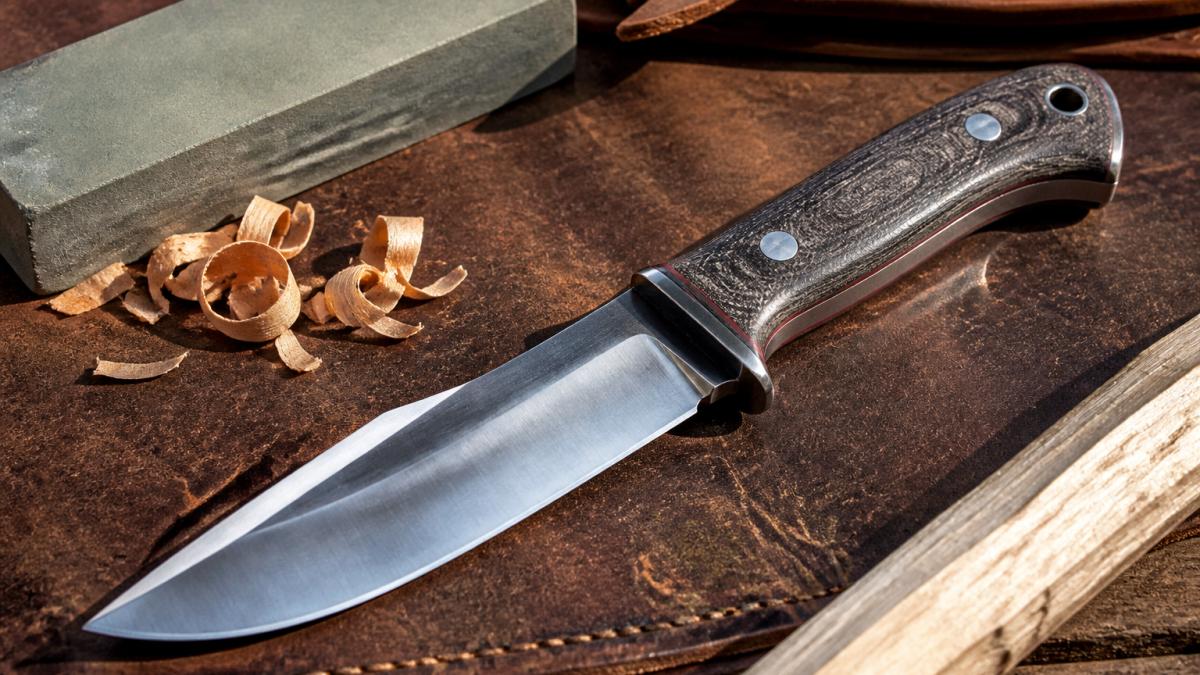 Custom hunting knife with a flat grind resting on weathered leather beside a sharpening stone and wood shavings
Tang construction matters too. A full tang runs the steel through the entire handle for maximum strength and balance, which is why we favor it on field knives. A knife with excellent steel but a poor grind will still fight you on every cut.
Best Steel for Custom Fillet Knives: Flexibility, Corrosion Resistance, and a Thin Edge
The best steel for custom fillet knives prioritizes corrosion resistance, flexibility, and a thin edge above all else. Fillet work happens wet, often around salt water, so a stainless or highly corrosion-resistant steel earns its place.
Flexibility and thinness are geometry problems as much as steel problems. A blade ground too thick will crack a fillet instead of following it. For anglers, we lean toward corrosion-resistant steel with a fine, flexible profile, and we build the handle for a wet, gloved grip. You can see how we approach this in our Damascus midsize kitchen knife.
 The Damascus midsize Kitchen knife
How to Maintain a Custom Hunting Knife Edge: Honing, Stropping, and Rust Prevention
Learning how to maintain a custom hunting knife edge comes down to three habits: hone before it dulls, strop to realign, and keep the steel dry. Honing with a fine stone or ceramic rod maintains the edge between full sharpenings. Stropping on leather realigns the micro-edge and restores a razor bite without removing metal.
For rust prevention, wipe the blade dry after every use, apply a thin coat of oil or wax, and store it outside the sheath. Diamond and cubic boron nitride (CBN) stones cut fast on wear-resistant steels, but use them sparingly, since aggressive sharpening removes metal you cannot put back.
Pro Tip
Strop after every hunt, sharpen only when stropping stops working. Most hunters sharpen far too often and remove years of blade life in the process.
Conclusion: Build the Knife Around the Hunt, Not the Spec Sheet
The steel chart will not tell you which blade belongs in your hand. The hunt will. Match hardness, toughness, and corrosion resistance to the game you chase and the conditions you hunt in, then let geometry and heat treatment do the rest.
That is exactly how we build at GS Custom Knives. Every knife is handcrafted to suit specific needs, with custom blade shapes and sizes and personalized handles for grip and comfort, all backed by our lifetime satisfaction guarantee. Tell us what you hunt, and we will forge the blade around it.
Frequently Asked Questions
What type of steel is best for a hunting knife?
There is no single best steel. For most deer and elk hunters, a high-carbon or tool steel hardened to roughly 58-60 HRC gives a good balance of edge retention and toughness. If you hunt in wet or coastal conditions, a stainless steel with higher chromium content makes more sense because it resists corrosion with less maintenance. The right pick depends on your game size, climate, and how often you are willing to sharpen.
Is stainless steel or carbon steel better for custom hunting knives?
Carbon steel typically takes a keener edge and is easier to sharpen with simple stones, but it rusts quickly and needs oiling after every trip. Stainless steel holds up better in rain, snow, and saltwater and needs less day-to-day care, though some grades are harder to sharpen in the field. Many hunters choose carbon steel for a dedicated skinning knife and stainless for a fillet or backup blade.
How does heat treatment affect the performance of custom knife steel?
Heat treatment determines how the steel's grain structure forms, and it has more impact on performance than the alloy name alone. The same steel hardened to 58 HRC versus 61 HRC behaves like two different materials: the harder version holds an edge longer but chips more easily, while the softer version rolls and dents instead of cracking. Cryogenic treatment, when a maker uses it, can further refine grain structure and improve edge stability.
Which steel is best for field dressing and skinning?
For field dressing and skinning, look for a steel that balances edge retention with toughness in the 58-60 HRC range, paired with a thin flat or hollow grind. You want an edge that slices through hide and connective tissue without micro-chipping when it contacts bone. A full tang construction and a comfortable handle matter as much as the steel, since you may be working in cold, wet conditions for an hour or more.