Table of Contents
Last Updated: October 11, 2026
Why Custom Knives Hold Edge Longer: The Core Differences
Custom knives hold their edge longer due to three factors: superior steel selection, precise heat treatment, and intentional blade geometry. These elements compound to create tools that outperform factory knives by years.
The difference comes down to control. Craftspeople choose every variable: steel composition, heat treatment tailored to that steel, and blade angle matched to intended use. Mass producers optimize for speed and cost; custom makers optimize for performance.
Edge retention, how long a blade stays sharp, directly determines a knife's value. A blade that dulls in three weeks becomes frustrating; one that holds its edge for months becomes indispensable.
Pro Tip
The sharpness of a custom knife isn't just about the initial edge. It's about how the blade's microstructure resists the wear that dulls it. This is where heat treatment and steel composition create measurable differences.
Carbon Steel vs Stainless Steel Knife Edge Retention
The choice between carbon steel and stainless steel shapes everything about edge retention. Carbon steel holds a sharper edge longer. Stainless steel resists corrosion better. Understanding this trade-off is essential when choosing a custom knife.
Carbon steel contains iron and carbon, sometimes with chromium or vanadium. High-carbon steel hardens to higher levels than most stainless alloys, resisting abrasion and dulling better than stainless alternatives.
Carbon steel rusts without care and requires regular maintenance, occasional oiling for outdoor use, prompt hand washing and drying for kitchen use.
Stainless steel adds chromium (usually 12% or more) to resist corrosion, making it harder to achieve the same hardness levels as carbon steel. Edge retention is good but not exceptional. However, stainless steel forgives neglect and won't rust if left wet.
For edge retention, carbon steel wins. The Damascus midsize kitchen knife uses folded 1095 and 15N20 high-carbon steels, with harder outer layers holding the edge while inner layers provide toughness.
 The Damascus midsize Kitchen knife
Stainless options like our cryogenically treated 440 stainless steel models sacrifice some edge retention for corrosion resistance, ideal for wet environments like the Bass Tournament fillet knife.
Key Takeaway
Carbon steel holds an edge longer. Stainless steel requires less maintenance. The best choice depends on your environment and how much care you'll invest.
How Heat Treatment Affects Knife Edge Retention
Heat treatment is where custom knives pull ahead of production alternatives. This process determines the steel's hardness, toughness, and edge-retention capability. A craftsperson who understands heat treatment can extract maximum performance from any steel.
The process involves heating steel to a specific temperature, then cooling it in a controlled way. The right temperature creates a microstructure that holds an edge; too cool and the blade stays soft, too hot and it becomes brittle.
Hardness is measured on the Rockwell scale. Most production knives fall between 54-58 HRC; custom knives often reach 58-62 HRC. A blade at 60 HRC dulls more slowly than one at 56 HRC.
Cryogenic treatment cools the blade to extremely low temperatures, then gradually warms it, refining the steel's microstructure so carbides become more uniform and stable. The result is a blade that holds its edge longer and resists chipping better.
Our Super Chef knife uses cryogenically treated 440 stainless steel at 58-59 HRC, with hard particles distributed evenly for consistent edge retention. The Beautiful 10" fillet with cryo reaches the same hardness with identical microstructure benefits.
Tempering follows hardening, slightly softening the blade to reduce brittleness. Custom makers adjust tempering based on intended use: fillet knives need more toughness than chef's knives, hunting blades must survive impact.
Mass production cuts corners with standardized heat-treat cycles for all steels and shapes. Custom makers adjust the process to each specific steel and use.
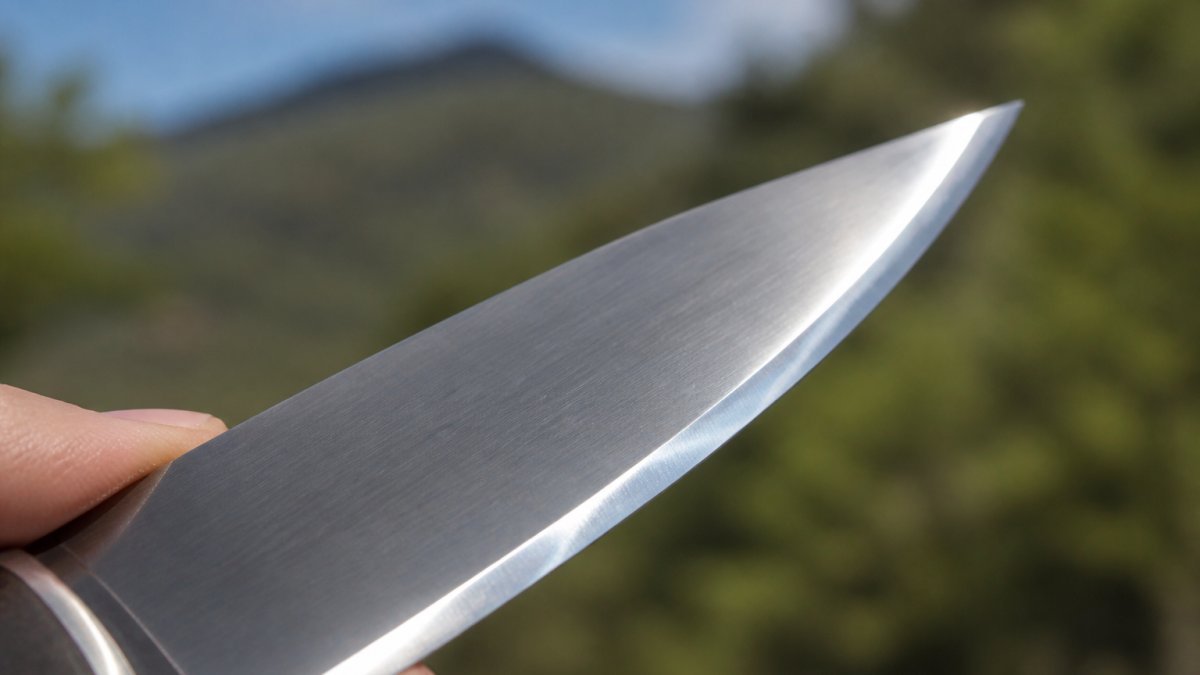 Close-up of a custom knife blade held at a precise angle to natural light, showing the refined edge geometry and polished bevel surface
Knife Blade Geometry and Sharpness: Edge Angle and Grind
The blade's shape, its geometry, determines how the edge performs. Two knives made from identical steel can have drastically different edge retention if their geometry differs. This is where blade angle and grind style matter.
Edge angle is the angle at which the blade comes to a point. Japanese knives typically use 15-18 degrees; German knives use 20-22 degrees. Wider angles are more durable but dull faster; narrower angles stay sharper longer but chip more easily.
Custom makers choose the angle for specific use: fillet knives get sharper angles, hunting knives get more durable angles. Mass production cannot make this intentional choice.
Grind describes how the blade tapers from spine to edge. Hollow grind creates a concave surface, reducing friction; flat grind is stronger and holds an edge longer; convex grind is the toughest option.
Hand grinding allows makers to create ideal grinds for specific tasks: the hollow-ground Super Chef reduces drag when slicing vegetables; fillet knives use grinds optimized for fish processing.
Blade thickness affects edge retention: thicker blades are tougher but dull faster; thinner blades stay sharper longer but chip more easily. Custom makers adjust thickness based on purpose and steel properties.
These geometric choices compound. A well-chosen angle plus appropriate grind plus correct thickness creates a blade that outperforms competitors made from better steel but with generic geometry.
Watch Out
An overly sharp angle might seem ideal, but it creates a fragile edge that chips easily during real use. The best custom knives balance sharpness with durability for the specific task.
Custom Craftsmanship vs Production Knives: A Practical Comparison
Production knives prioritize volume and cost; custom knives prioritize performance. This fundamental difference shows in edge retention.
Production facilities make thousands of identical knives through standardized heat-treat cycles and sharpening. This consistency is valuable but means no adjustment for steel batch variations or intended use.
Super Chef knife with cryogenically treated 440 stainless Steel →
Custom makers produce fewer blades with individual attention. Heat treatment adjusts for steel batch variations; blade geometry adapts to client specifications. This flexibility creates better outcomes.
Consider the difference in sharpening. Production knives are sharpened on automated systems. Fast, consistent, but generic. Custom makers hand-sharpen each blade. They can create the ideal edge for that specific steel and that specific grind. They can feel the steel and adjust technique.
The Damascus midsize kitchen knife demonstrates this. It's hand-forged from 1095 and 15N20 steels folded 256 times. The layered structure creates a blade with exceptional edge retention and visual character.
Quality control differs too. Production facilities inspect a sample of blades. Custom makers inspect every blade. A defect in a production run might slip past. A defect in a custom blade stops the maker from shipping it. This accountability shows in durability.
Every decision, steel choice, heat treatment, geometry, and sharpening is optimized for actual performance.
| Aspect |
Custom Knives |
Production Knives |
| Steel selection |
Chosen for specific use |
Standardized across models |
| Heat treatment |
Tailored to steel and purpose |
Fixed cycle for all blades |
| Blade geometry |
Optimized for intended task |
Generic for broad appeal |
| Sharpening |
Hand-honed with adjustment |
Automated, standardized |
| Quality control |
Individual inspection |
Sample-based |
| Edge retention |
Optimized for performance |
Baseline |
How to Maintain a Knife Edge for Long-Term Performance
Edge retention depends partly on the knife's construction and partly on how you use it. Proper maintenance extends the life of any blade, custom or production.
Use the right cutting board. Wood and plastic are gentle. Glass and ceramic are brutal. They'll dull any blade quickly. A soft cutting surface preserves edge retention more than any other single habit.
Cut with intention. Slicing motions preserve edges better than chopping. Let the blade do the work. Don't force it through hard materials. Pushing harder doesn't cut better, it dulls the edge faster.
Wash by hand. Dishwashers damage blades. The heat, the tumbling, the abrasive detergent, all wear the edge. Hand wash with mild soap and dry immediately. This simple step adds months to edge life.
Hone regularly. Honing realigns the edge without removing metal. A honing steel takes 30 seconds and restores sharpness. Do this weekly if you use the knife daily. It's the easiest way to maintain edge retention.
Sharpen less often. When honing stops working, sharpen. Sharpening removes metal to create a new edge. It's necessary but should happen infrequently, every few months for daily-use knives. The better the blade, the longer between sharpenings.
Store safely. A knife block or magnetic strip keeps the edge protected. Loose knives in a drawer bang against each other. Each impact dulls the edge slightly. Good storage preserves edge retention.
Avoid impact. Don't chop through bone with a chef's knife. Don't use a fillet knife to pry. Don't drop the blade on hard surfaces. Impact damage dulls the edge instantly and can chip it.
 The Bass Tournament fillet knife with Cryo
These practices work with any knife. But they work best with a custom blade because a well-made knife rewards good care. The edge retention you gain from proper maintenance compounds the edge retention built into the blade itself.
Choosing the Right Custom Knife for Your Specific Use
Edge retention matters only if the blade suits your actual needs. Choosing the right custom knife means matching steel, geometry, and size to your specific use.
For kitchen work, a chef's knife needs to stay sharp through extended prep. High-carbon steel like the Damascus midsize kitchen knife excels here. The blade cuts vegetables, proteins, and herbs repeatedly. A hand-forged blade with optimized geometry maintains sharpness for weeks of regular use.
For fishing, a fillet knife must handle saltwater and delicate work. Stainless steel resists corrosion. The Bass Tournament fillet knife with cryo treatment handles this environment. The narrow blade slides along bones. The cryogenic treatment ensures consistent edge retention despite wet conditions.
For hunting, a fixed blade needs toughness and reliability. It might contact bone or hide. A blade angle around 20-22 degrees balances sharpness with durability. Custom makers can adjust heat treatment to create a blade that holds an edge through field use.
For outdoor work, a general-purpose blade needs versatility. It might cut wood, rope, or food. A mid-range angle (18-20 degrees) and moderate hardness create a blade that handles varied tasks. Custom geometry can optimize for your specific cutting style.
The Super Chef knife with cryogenically treated 440 stainless steel represents a kitchen-focused choice. The hollow grind reduces drag. The hardness reaches 58-59 HRC. The blade length of 9-3/4" handles most prep tasks. The stainless steel forgives occasional neglect.
Consider your maintenance commitment too. Carbon steel requires more care but offers superior edge retention. Stainless steel requires less care but won't match carbon steel's longevity. A custom maker can help you balance these factors based on your actual lifestyle.
Best For
Serious home cooks who use knives daily and are willing to hand wash and store properly. The investment in a custom blade pays back through years of superior edge retention.
Understanding why custom knives hold edge longer reveals that every element is optimized for performance. The lifetime satisfaction guarantee means you can invest in a blade designed to last. Learn more about proper knife maintenance from official culinary standards to extend your blade's life even further.
Frequently Asked Questions
Which steel holds an edge longer: carbon or stainless?
Carbon steel and high-carbon stainless steel typically hold edges longer than standard stainless because they achieve higher hardness levels through heat treatment. Carbon steel can reach 62+ HRC hardness, allowing it to maintain a sharper edge through more cuts. Stainless steel trades some edge retention for corrosion resistance, though premium stainless options like 440 stainless steel, especially when cryogenically treated, can rival carbon steel performance in many applications.
How does heat treatment affect a knife's edge retention?
Heat treatment determines a blade's hardness, toughness, and wear resistance through controlled heating and cooling. Tempering adjusts hardness levels: higher hardness (58-62 HRC) extends edge life but increases brittleness, while lower hardness improves durability but dulls faster. Cryogenic treatment, which cools steel to -305 degrees, aligns carbides in the microstructure for improved edge stability and longer edge life. Custom makers fine-tune these parameters for specific uses.
Does blade geometry affect how long a knife stays sharp?
Yes. Blade geometry, including edge angle, bevel shape, and blade thickness, directly influences edge retention. A thinner, lower-angle edge (15-20 degrees) stays sharper longer but is more prone to chipping. Thicker blades with higher angles (25-30 degrees) resist chipping better but dull faster. Custom knives are designed with geometry optimized for their intended use: fillet knives use acute angles for clean cuts, while field knives use stronger angles for durability.
How often should you sharpen a custom knife?
Sharpening frequency depends on use intensity and steel type. A well-maintained custom knife in high-carbon or cryogenically treated steel may need sharpening every 3-6 months with regular use, or annually with light use. Honing, realigning the edge between sharpenings, extends intervals. Proper maintenance, including regular honing and avoiding cutting boards that dull edges quickly, can significantly reduce sharpening frequency and preserve edge life.