Table of Contents
Last Updated: October 2, 2026
Why Kitchen Knife Handle Material Matters
A kitchen knife handle is the interface between your hand and the blade, determining how safely and comfortably you work. Steel gets the glory, but the handle decides whether a knife feels like an extension of your arm or a tool you fight with.
 The prestige slicer
At GS Custom Knives, we build every blade around the person who will use it, so handle selection comes first. Your material choice affects grip, moisture resistance, weight distribution, and how the knife ages.
This guide breaks down the real options, from the U.S. Food and Drug Administration's food contact surface guidance to composite construction, so you can choose with confidence. Below, we'll show you exactly which materials hold up in a working kitchen and which ones belong on a display shelf.
The Best Wood for Kitchen Knife Handles
The best wood for kitchen knife handles balances hardness, grain tightness, and treatment. Dense hardwoods like cocobolo, rosewood, and maple resist dents and take a fine finish, but untreated wood is porous and absorbs moisture, which is why stabilization matters for any knife headed into a wet kitchen.
Natural wood remains the classic choice for custom cutlery because no two pieces look alike. The grain of a burl or figured maple gives each knife an identity.
 Kitchen Carving Set with solid maple cutting board
Wood does have trade-offs: it expands and contracts with humidity and needs periodic care to stay sealed. Choose it for character and warmth, but commit to maintenance.
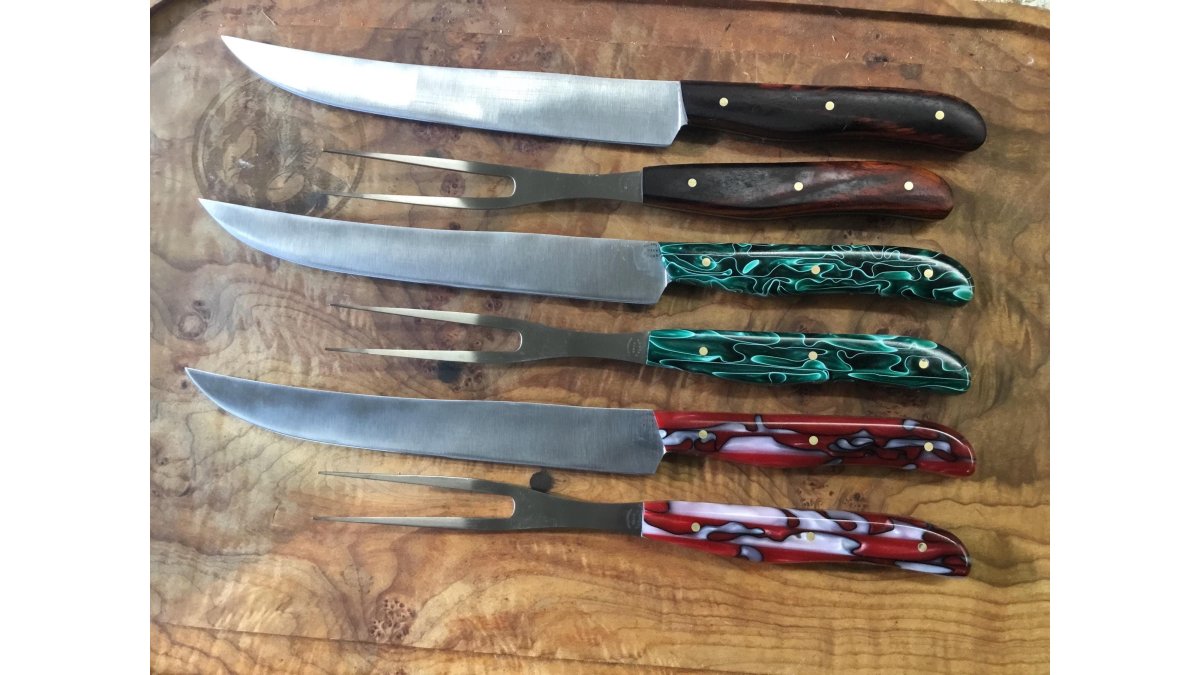 Kitchen Carving Set with solid maple cutting board
Stabilized Wood and Resin Treatments
Stabilized wood is natural wood that has been impregnated with resin under vacuum and pressure, filling the wood's pores with a hardened polymer. The result keeps the grain pattern you love while adding moisture resistance and dimensional stability that raw wood cannot match.
A properly stabilized blank absorbs resin throughout its thickness, not just at the surface, which is why stabilized maple holds up far better against kitchen humidity and repeated washing. The resin also increases hardness and impact resistance, reducing chips or cracks at the tang.
For a kitchen environment, stabilized wood is almost always the smarter pick over an untreated block: natural wood looks with composite durability.
G10 vs Micarta for Kitchen Knives
G10 and Micarta are both composite materials built from layers of fabric or fiber bonded with resin, and both are excellent for kitchen knives. The difference comes down to what's inside: G10 uses fiberglass cloth, while Micarta typically uses linen, canvas, or paper.
G10 is denser and more moisture-resistant: its fiberglass layers and phenolic resin shrug off water, heat, and staining.
| Material |
Base |
Moisture Resistance |
Feel |
Best For |
| G10 |
Fiberglass + phenolic resin |
Excellent |
Firm, uniform |
High-humidity kitchens, heavy use |
| Micarta |
Linen/canvas + resin |
Very good |
Slightly softer, patinas |
Users who want grip and character |
| Stabilized wood |
Resin-filled hardwood |
Very good |
Warm, natural |
Those who want grain pattern |
| Metal |
Stainless steel |
Excellent |
Hard, slick when wet |
Sanitary commercial settings |
Key Takeaway
If you work in a wet, busy kitchen and want the least fuss, G10 and Micarta beat untreated wood every time. If you want warmth and grain, go stabilized wood.
How Each Composite Handles Moisture and Heat
Moisture resistance is where composites pull ahead of raw natural materials. G10's fiberglass-and-resin construction absorbs almost no water, so it won't swell, crack, or harbor bacteria in surface pores like untreated wood.
The prestige slicer →
Metal handles, usually stainless steel, offer the highest corrosion resistance and easiest cleaning. They're common in commercial settings where sanitation is paramount, but they feel cold and get slick when wet, so grip texture matters more.
Watch Out
Smooth metal and polished bone handles get dangerously slick when coated in fat or water. If you handle wet proteins often, choose a textured grip material or a handle with a shaped, contoured geometry.
Sanitation and Food Safety Standards for Handle Materials
Food-safe handle materials must resist moisture absorption and clean easily, because porous surfaces trap bacteria, oils, and food particles a quick wipe won't remove. This is where kitchen knives diverge most sharply from field knives: a field knife can tolerate an open-grain wood handle that dries between trips; a kitchen knife faces raw proteins, fats, and standing water daily.
For a kitchen knife, look for four things:
-
A fully sealed surface. No exposed end grain, no open pores, no unfinished patches near the tang.
-
A tight tang-to-handle junction. Gaps, visible epoxy lines, or a loose fit create a harbor for moisture and food particles that no amount of surface wiping will reach.
-
No cracks, checks, or delamination. A hairline crack in wood or a lifted layer in Micarta is a bacterial reservoir, not a cosmetic flaw.
-
A food-grade finish. Oils, waxes, and resins used on the handle should be rated for food contact, not shop-grade finishes intended for furniture.
Watch Out
A beautiful handle with a loose tang seam is less sanitary than a plain handle with a tight one. Ask your maker how the handle meets the tang before you ask about the wood species.
Pro Tip
Even the best handle needs a clean seam. A tight, sealed junction leaves nowhere for water and food to hide, which matters more than the material itself. If you cook with raw proteins often, prioritize a closed-surface material and a sealed junction over grain figure every time.
Ergonomics, Weight, and Balance in Handle Design
Ergonomics in a knife handle come down to geometry: the shape, thickness, and contour that determine how your hand wraps the grip. A handle that fits reduces fatigue and improves control, translating into safer, more consistent cuts.
Stabilized Wood Knife Handle Maintenance
Stabilized wood knife handle maintenance is straightforward: wash by hand, dry immediately, and re-oil occasionally to keep the surface sealed. Never soak a wood-handled knife or run it through a dishwasher, since heat and moisture degrade treated wood and can soften the resin filling the pores.
Repairing and Refinishing a Worn Handle
Most handle problems are cosmetic and reversible, and knowing the sequence saves you from making them worse: clean, assess, sand, seal, and re-oil. Work slowly and test on a small area first.
Key Takeaway
Stabilized wood rewards a small amount of routine care and forgives a surprising amount of wear. Most handles can be brought back with a grit progression, a fresh seal, and a few minutes of patience, no replacement required.
Conclusion
Choosing handle material is a balancing act between feel, durability, sanitation, and looks, with no single right answer for every cook. What matters is matching the material to how you actually use the knife, then caring for it properly.
Frequently Asked Questions
What is the best material for a kitchen knife handle?
There is no single best material, but stabilized wood and G10 are the top choices for kitchen use. Stabilized wood offers warmth and a unique grain pattern while resisting moisture through resin treatment. G10 provides near-zero water absorption and high impact resistance. Micarta sits between the two, offering a slightly softer feel with strong durability. Your choice depends on whether you prioritize aesthetics, grip texture, or maximum moisture resistance.
Is Micarta or G10 better for kitchen environments?
G10 edges ahead in kitchen environments because it absorbs almost no moisture and resists heat well. Micarta handles moisture adequately but can feel slightly more porous over years of heavy use. Both are composite materials made with phenolic resin, so both resist corrosion and staining. If you wash your knives frequently or work in a humid kitchen, G10 is the safer long-term pick. Micarta offers a warmer, more textured grip that some cooks prefer.
How do natural wood handles compare to synthetic materials in the kitchen?
Natural wood handles, especially stabilized wood, deliver warmth, aesthetic appeal, and a comfortable grip that synthetics cannot match. The trade-off is maintenance: wood needs occasional mineral oil treatment to prevent drying and cracking. Synthetic materials like G10 and Micarta require almost no upkeep and handle moisture and heat with less risk of swelling. For a kitchen knife used daily and washed often, synthetics reduce long-term care.
What are the maintenance requirements for custom knife handle materials?
Stabilized wood handles need a light coat of mineral oil or a food-grade finish every few months to keep the grain sealed and prevent drying. G10 and Micarta handles need only soap and water, though a occasional wipe with food-safe oil keeps them looking new. Metal handles resist moisture but can become slippery when wet. Regardless of material, avoid soaking any handle in water and dry it thoroughly after washing to extend its life.
Which handle materials are most resistant to moisture and heat?
G10 and carbon fiber rank highest for moisture and heat resistance because their resin matrices seal out water completely. Stabilized wood comes next, since the resin treatment fills the wood's pores and blocks moisture absorption. Micarta resists moisture well but may absorb slight amounts over time if the surface wears. Bone and stag are the least resistant and require more careful drying and conditioning to prevent cracking in a kitchen setting.
How does handle material affect grip and ergonomics?
Handle material directly influences grip texture, weight distribution, and how the knife feels during long prep sessions. G10 can be textured for a secure hold even when wet, while stabilized wood offers a smooth, warm feel that reduces hand fatigue. Micarta provides a slightly tacky surface that many chefs find comfortable. Heavier materials like metal shift the knife's balance toward the handle, which can help with control during chopping but may tire your wrist faster.