Table of Contents
Last Updated: October 12, 2026
Why Custom Knives Cost More Than Production Knives
A custom knife is a blade made to order by a single maker, while a production knife is built on a factory line in large batches.
Custom knives cost more because a maker builds one knife at a time, by hand, to your specs. A factory spreads its costs over thousands of identical units.
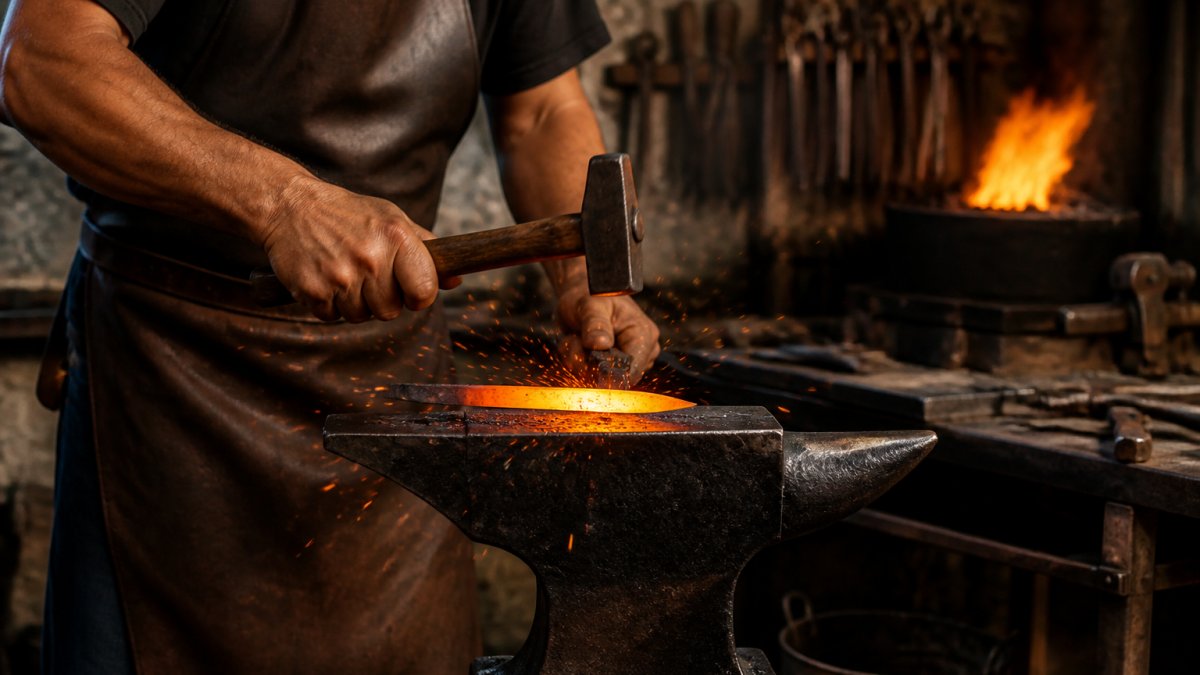 A bladesmith's hands shaping a glowing steel blade on an anvil in a workshop, sparks visible, leather apron and tools in the background
The Real Difference Between Handmade and Mass-Produced
Mass-produced knives are stamped or laser-cut from sheet steel, then finished by machine in minutes. Handmade knives are forged, ground, heat treated, and finished by a person who checks every step.
That human attention is the product. It is also the cost.
- Production: one worker oversees hundreds of blades a day
- Custom: one maker spends hours on a single blade
- Production: standard patterns, no changes
A common mistake is assuming the steel alone drives the price. It does not. Labor and skill usually matter more.
A Transparent Cost Breakdown: Where Your Money Goes
Most knife buyers never see a real cost breakdown, so here is one. Every custom knife price comes down to four buckets: materials, labor, overhead, and the maker's margin. The materials are only part of it.
Materials, Labor, and Overhead Line by Line
-
Steel: high-carbon or stainless billets, including layered Damascus
-
Handle material: hardwood, stabilized maple, resin, and other stocks
-
Labor: forging, grinding, heat treating, and hand finishing hours
The American Bladesmith Society notes that hand-forging a blade involves multiple heats and careful control at each stage, which is why forged knives take far longer to produce than stamped ones. You can read more via the American Bladesmith Society on bladesmithing.
Key Takeaway
Labor, not steel, is the biggest line item in most custom knives. A premium billet might add a modest amount; the hours spent shaping it add far more.
How Much Does a Custom Knife Cost? Price Tiers Explained
Custom knife prices fall into recognizable tiers, but the tier is not set by size alone. What moves a build from one band to the next is the number of hours, the difficulty of the steel, the complexity of the handle, and the maker's experience level.
A useful way to think about it: price tracks time and risk. Anything that adds steps, failure points, or waiting time adds cost.
What Each Tier Buys You
| Tier |
Typical Price Band |
What Drives the Price |
Best For |
| Entry custom |
Roughly $100-$200 |
Simple carbon or stainless steel, stock removal or light forging, basic handle, minimal file work |
First custom, everyday kitchen or utility use |
| Mid custom |
Roughly $200-$500 |
Forged blade, pattern-welded or Damascus steel, premium stabilized handle, hand-finished spine and choil |
Hunters, anglers, serious cooks, gift buyers |
| High custom |
Roughly $500-$1,500+ |
Complex Damascus patterns, exotic or museum-grade handle material, one-off design, engraving, leather or kydex sheath |
Collectors, investors, heirloom buyers |
These bands are guides, not rules. A well-known maker with a multi-year waitlist can charge above the band for the same specifications, because demand and reputation are part of the price. A newer maker may sit at the bottom of a band while building a portfolio.
The Specific Choices That Add Cost
-
Steel type. A simple high-carbon billet is the least expensive option. Pattern-welded Damascus multiplies the forging time because every layer must be stacked, welded, and drawn out without a flaw. Powder-metallurgy stainless steels cost more per bar and are harder to grind and heat treat.
-
Blade geometry. A flat grind is faster to cut than a complex convex or hollow grind. A tapered tang, distal taper, or a hand-finished plunge line adds hours.
-
Handle construction. A simple two-piece scale handle is quicker than a full tang with bolsters, spacers, and a mosaic pin. Stabilized wood and resin composites add a curing or vacuum step.
How Lead Time Connects to Price
Lead time and price move together. A maker quoting a two-week turnaround is usually building a simpler knife or working from a shorter queue. A maker quoting six months to two years is signaling demand, complexity, or both. When you compare quotes, compare the lead time alongside the number, because a lower price with a much longer wait may not be the better deal.
Key Takeaway
Ask any maker to break a quote into steel, handle, finish, and sheath. A maker who can explain the line items is usually the one who can also explain why one build costs more than another.
Custom Knife vs Production Knife: Which Fits Your Use Case?
The honest answer is that a custom knife is not automatically better for every job. The right choice depends on how often you use the blade, how hard you use it, and whether the fit and finish matter to you. Most buyers get better value by matching the knife to the task rather than to the price tag.
When a Custom Knife Earns Its Price
-
Repeat, heavy use. If you process game, break down fish, or cook daily, a custom blade that fits your hand reduces fatigue and holds an edge longer between sharpenings. The cost per use drops the more you use it.
-
Fit and ergonomics. A production handle is sized for an average hand. A custom handle is shaped to yours, which matters for people with larger or smaller hands, or with grip issues.
-
Specific geometry. If you need a particular blade length, grind, or tip shape that no production model offers, custom is the only route.
When a Production Knife Is the Better Buy
-
Occasional or light use. If the knife lives in a drawer and comes out a few times a year, a production knife does the job at a fraction of the cost.
-
Hard, abusive tasks. Batoning, prying, or loaning a knife to someone who may misuse it is a poor fit for an expensive custom. A sturdy production blade absorbs that risk better.
-
Trying a new style. If you are not sure whether you prefer a drop point or a clip point, a production knife lets you experiment before committing to a custom build.
A Simple Decision Framework
-
How often will you use it? Daily or weekly use favors custom. A few times a year favors production.
-
Does the handle fit matter? If a production handle already feels right, you may not gain much from custom.
-
Do you need a specific design? If no production model matches your needs, custom is the answer.
-
Will you maintain it? Custom knives reward care. If you will not dry, oil, and sharpen, a production knife may serve you better.
-
Is resale or heirloom value part of the goal? If so, custom carries more weight.
Pro Tip
If you are on the fence, buy one production knife in the style you think you want, use it for a season, and note what you would change. Those notes become the specification for your first custom build.
Custom Knife Handle Materials and What They Add to the Price
Handle materials change both the feel and the cost of a custom knife. Common choices include stabilized maple, resin composites, and dense hardwoods like Cocobolo.
Custom Damascus hunting knives →
Stabilized woods are treated to resist moisture and cracking, which adds a step to the build. Resin handles offer durability and bold color.
What most guides miss is that the handle is where a maker spends a surprising amount of time.
Pro Tip
Ask your maker how the handle is sealed before you buy. A well-finished handle resists moisture and swelling, which matters for hunters and anglers who work in wet conditions.
How to Evaluate a Custom Knife Before You Buy
Judging a custom knife comes down to fit, finish, and honest answers from the maker. You do not need to be an expert. You need to know what to check.
-
Check the fit and finish. Look for even grinds and a handle that meets the steel cleanly.
-
Ask about the steel and heat treatment. The heat treatment decides edge retention and toughness.
-
Test the grip. A knife should feel balanced and secure in your hand.
-
Ask about the grind. Flat, convex, and hollow grinds suit different jobs.
-
Confirm the warranty. A lifetime guarantee tells you the maker stands behind the work.
-
Ask about lead time. Custom work takes time; get a realistic date up front.
-
Review the maker's past work. Photos and past builds show their skill level.
For more on what separates a good blade from a great one, see the Knife Steel Nerds guide to steel properties, which breaks down hardness, toughness, and edge retention in plain terms.
Maintenance, Repair, and Lifetime Cost of Ownership
A custom knife usually costs less to own over time, even though it costs more up front. High-carbon and Damascus blades can be resharpened, repaired, and refinished. A production knife often gets replaced instead.
-
Sharpening: custom blades hold an edge longer, so you sharpen less often
-
Repair: handles and edges can be reworked by the maker
-
Resale: well-kept custom knives hold value better than mass-produced ones
-
Warranty: a lifetime guarantee cuts long-term repair costs
The catch is care. High-carbon steels can rust if left wet, so dry and oil your blade after use. Treat it well and it can last a lifetime.
Are Custom Knives Worth the Money?
Custom knives are worth it if you value fit, durability, and a tool built for you. They are not worth it if you want the cheapest blade that gets the job done.
Buying custom also means you can shape the knife around your needs. If you are not sure what shape or handle size you want, a good maker walks you through the options and helps you decide.
Consumer product warranty basics from the Federal Trade Commission
Watch Out
Do not judge a custom knife by steel type alone. A well heat-treated mid-grade steel will outperform a poorly treated premium steel every time.
Frequently Asked Questions
Why do custom knives cost more than production knives?
Custom knives cost more because a single maker handles every step: forging, grinding, heat treating, and finishing. A production knife is stamped or laser-cut in batches on automated lines, which spreads the cost across thousands of units. A handmade knife takes 10 to 40 hours of skilled labor, plus premium steel and handle materials bought in small quantities rather than bulk. That labor and material difference is the bulk of the price gap.
How much does a custom knife cost, and what do you get at each price tier?
Entry-level custom knives typically start around $100, like the Damascus midsize kitchen knife at $100, which uses 256 layers of 1095 and 15N20 steel with a stabilized maple handle. Mid-tier options around $145 to $150, such as the custom Damascus hunting knife or the custom Damascus chef knife, add 512-layer steel, file work, and HRC 58-60 hardness. Higher tiers buy more complex geometry, exotic handle materials, and longer maker hours.
Which custom knife handle materials are worth paying extra for?
Handle materials affect both price and how the knife feels in hand. Stabilized maple and resin composites resist moisture and cracking, which matters for hunting and fishing knives. Cocobolo hardwood, used on some Damascus hunting knives, offers a dense, warm grip that holds up to field use. Exotic woods and synthetics cost more because they need stabilizing and hand-fitting, but they add durability and a personal fit you will not get from a molded factory handle.
Are custom knives worth the money compared to a production knife?
It depends on how you use the knife. For occasional light cutting, a production knife works fine. For hunters, anglers, or cooks who use a blade weekly, a custom knife pays off through better edge retention, a handle fitted to your grip, and repairability. A production knife with a chipped edge often gets replaced; a custom blade can be resharpened, rehandled, and passed down, which lowers the lifetime cost per year of use.
The hardest part of buying custom is knowing what you actually need. GS Custom Knives takes that pressure off. We hand-forge every blade from superior steel, shape it to your specs, and finish the handle for a grip that fits your hand. Every knife comes with our lifetime satisfaction guarantee, so you can order with confidence. Get started with GS Custom Knives and carry a blade built to last.