

Last Updated: October 25, 2026
Quick Summary
Cryo-treated steel can modestly improve edge retention by finishing the martensite transformation and reducing retained austenite, but it cannot rescue a bad steel or a bad grind. It helps most on high-alloy, high-carbon steels with stubborn retained austenite, and least on simple steels that already convert cleanly. Treat it as one variable in the heat-treat sequence, not a universal upgrade.
- Cryogenic treatment slots in between the quench and the temper, so skipping the temper leaves a hard, brittle blade.
- Montana Knife Company puts typical hunting knife hardness at 60-62 HRC and stresses heat treatment matters as much as steel choice.
- A defensible cryo comparison holds steel grade, austenitizing temperature, quench, temper, geometry, and sharpening constant.
- A 2021 study led by T. Shinde found deep cryo improved corrosion properties of H13 die steel, not hunting-knife steel.
- The Badlands Skinner states its hardness outright at RC 56-57, the kind of number we wish every maker published.
Table of Contents
- What Cryogenic Treatment Actually Does to Blade Steel
- Cryo-Treated vs Heat-Treated Steel: The Real Difference
- Knife Steel Edge Retention: What Cryo Can and Cannot Fix
- Knife Steel Toughness: The Trade-Off Hunters Feel First
- The Best Steel for a Hunting Knife Depends on the Heat Treat
- Where Cryo Falls Short: Downsides and Evidence Gaps
- Field-Ready Cryo Blades in the GS Custom Knives Lineup
- Choosing Your Hunting Knife: What to Ask Before You Buy
- Frequently Asked Questions
What Cryogenic Treatment Actually Does to Blade Steel
Cryogenic treatment is the controlled cooling of hardened steel to very low temperatures, holding it there, then returning it to room temperature for tempering. It does not coat the blade or change its chemistry, it changes the steel's internal structure.
After quenching, some austenite stays trapped instead of converting to martensite, and cryo gives that transformation more room to finish (Cryogenic Processing of Steel Part 1 - Maximizing Hardness).
Step by Step: How Cryo Fits Into the Heat-Treat Process
- Austenitize: heat the steel to its hardening temperature so carbon and alloy content go into solution.
- Quench: cool fast enough to form martensite, which is where most of the hardness comes from.
- Cryogenic soak: cool further to sub-zero processing temperature and hold for a set soak time.
- Temper: reheat to relieve residual stress and dial in the hardness-toughness balance.
- Finish: grind, sharpen, and polish, watching cooling rate and heat buildup at the edge.
Skip step four and you get a hard, brittle blade. That is the mistake. Cryo without a proper temper is worse than no cryo at all.
Cryo-Treated vs Heat-Treated Steel: The Real Difference
Cryo-treated steel and heat-treated steel are not two separate processes, it is one process with an extra step. Conventional heat treatment covers austenitizing, quenching, and tempering; cryogenic treatment slots in between the quench and the temper.
Montana Knife Company puts typical hunting knife hardness at 60-62 HRC and stresses that heat treatment matters as much as steel choice. A well-treated mid-tier steel beats a premium steel with a sloppy heat treat every time.
Retained Austenite and Why It Matters
Retained austenite is soft, unstable steel left over after quenching that has not yet converted to martensite. Too much of it and an edge feels sharp but loses that sharpness quickly under load. Kizlyar Supreme frames cryo correctly: it matters most when the hardening route leaves retained austenite, or when testing shows a real improvement. On steels with a low MS temperature, more austenite stays behind, so cryo has more to work with.
Knife Steel Edge Retention: What Cryo Can and Cannot Fix
Cryo-treated steel can improve edge retention by finishing the martensite transformation and reducing retained austenite, but it cannot rescue a bad steel or a bad grind. Edge retention is a system: steel grade, hardness, microstructure, edge geometry, and sharpening all pull on the same rope. The hunting-specific question is narrower: does cryo change what happens at the edge during skinning, jointing, and trimming, and by how much?
What Edge Retention Actually Means in the Field
Edge retention in a hunting knife is not one number. It is the combination of:
- Abrasive wear resistance, how long the apex resists dulling when it cuts through hide, hair, and grit. Higher hardness and a more uniform martensitic structure generally help here.
- Edge stability, whether a thin, sharpened apex rolls, chips, or folds when it meets bone or is levered through a joint. This is where toughness and geometry dominate.
- Corrosion resistance at the edge, a micro-bevel that oxidizes or pits loses sharpness even if the steel is otherwise sound.
Cryo mainly targets the first item. It gives the steel a more uniform microstructure, which supports wear resistance at the edge. It does little for the second unless the heat treat and geometry are already right, and nothing for the third beyond what the alloy provides.
A Controlled Comparison: How to Tell Cryo From Geometry
Most claims about cryo and edge retention are confounded: two knives with different steels, grinds, edge angles, and heat-treat recipes are compared, and the treatment gets credit for differences geometry or alloy produced. A defensible comparison holds everything else constant:
- Same steel grade and mill lot. Different heats of the same grade can vary enough to muddy results.
- Same austenitizing temperature, quench, and temper. Only the cryogenic soak differs between the two blades.
- Same geometry and edge angle. A 15-degree-per-side edge and a 20-degree-per-side edge behave differently regardless of treatment.
- Same sharpening method and finish. A polished edge and a toothy edge wear differently on hide.
- Same test medium and motion. Repeated cuts through consistent material, with edge sharpness measured at intervals, not judged by feel alone.
With those controls in place, the honest expectation is a modest, steel-dependent improvement in wear resistance, not a step change. Cryo helps most when the conventional heat treat leaves measurable retained austenite, and least on steels that already convert cleanly. That effect is real but conditional, and smaller than the difference between a well-ground 20-degree edge and a poorly ground 15-degree edge on the same steel.
What Cryo Cannot Fix
What cryo cannot do is compensate for a 20-degree-per-side bevel on a knife you expect to skin with, a burnt edge from a careless grinder, or a steel that was never hard enough to hold an apex. If edge holding is your priority, read why custom knives hold an edge longer before you blame the steel. The treatment refines the heat treat; it does not substitute for getting the heat treat, grind, and edge angle right.
Practical Edge-Retention Guidance for Hunters
- Match edge angle to task. Skinning favors a thinner, keener edge; jointing and bone contact favor a slightly more obtuse, stable edge.
- Ask for hardness in HRC. A stated hardness is the single most useful number a maker can publish, because it tells you what the steel is actually doing.
- Expect cryo to help most on high-alloy, high-carbon steels with stubborn retained austenite. Expect less on simple steels and on processes that already convert cleanly.
Knife Steel Toughness: The Trade-Off Hunters Feel First
Knife steel toughness is the ability to absorb impact without chipping or cracking, and it is the property hunters feel first. Push hardness up and toughness usually comes down.
This is where cryo gets oversold. CTP Cryogenics describes cryogenic treatment as an enhancement to conventional processing, not a standalone method for substantially increasing hardness. If chipping is your worry, our guide to preventing blade chipping covers geometry and use habits that matter more than any treatment label.
The Best Steel for a Hunting Knife Depends on the Heat Treat
There is no single best steel for a hunting knife. There is a best heat treat for the steel you chose and the game you hunt.
The Blister Beetle Skinner with Cryo →
Off Grid Knives recommends CPM MagnaCut for corrosion resistance, toughness, and edge retention, which is a fair summary of why that steel earns attention. If you are weighing grades, our guide to choosing custom hunting knife steel walks through the trade-offs steel by steel.
Where Cryo Falls Short: Downsides and Evidence Gaps
Here is the part most guides skip: the evidence for cryo on hunting knives specifically is thin. A 2021 study led by T. Shinde concluded that deep cryogenic treatment improved the corrosion properties of H13 die steel, per the PubMed Central record. H13 is die steel, not hunting-knife steel, and the result gives no measured magnitude. That is a real finding about a different material.
Separating Mechanisms, Lab Results, Claims, and Anecdotes
Hunters deserve a clear hierarchy of evidence, because the cryo conversation mixes four things:
- Metallurgical mechanisms. Retained austenite transformation, carbide precipitation, and stress relief are well-described in the literature. The mechanisms are real; their magnitude in a given knife is not guaranteed.
- Laboratory findings. Studies on tool steels, die steels, and bearing steels show measurable improvements in wear resistance and dimensional stability under controlled conditions. Those results do not automatically transfer to a thin hunting-knife edge.
- Manufacturer claims. Makers legitimately describe their process, but "cryo-treated" is not a regulated term and does not specify temperature, soak time, cooling rate, or temper. A label is not a specification.
Hunting-Specific Trade-Offs Cryo Does Not Solve
Even where cryo helps wear resistance, it does not change the practical trade-offs hunters live with:
- Ease of sharpening. Harder, more fully transformed steel can take a keener edge but often takes more effort to restore in the field. A blade that holds an edge longer but is difficult to touch up can be a net loss on a multi-day hunt.
- Toughness at the edge. Pushing hardness up tends to reduce toughness. Cryo is not a license to run a hunting knife harder than its geometry and use support.
- Corrosion resistance. Cryo does not substitute for alloy choice or for basic care. A stainless blade still needs to be dried and oiled, and a carbon blade needs more attention regardless of treatment.
Steel-Specific Guidance: Where Cryo Earns Its Keep
Cryogenic treatment is not equally useful for every alloy. It matters most when:
- The steel is high-alloy and high-carbon, with a chemistry that leaves retained austenite after quenching.
- The hardening route and section thickness make complete martensite transformation difficult.
- The maker's process includes a proper temper after the cryogenic soak, which is non-negotiable.
It matters least on simple, low-alloy steels and on processes that already convert cleanly. Kizlyar Supreme notes cryo does not benefit every steel, it is a process variable, not a universal upgrade (Cryogenic Treatment of Knife Steel).
A Buying Checklist for Treatment Claims
- Steel grade named, not just "stainless"
- Hardness stated in HRC
- Heat-treat sequence described, including cryo temperature and temper
Three honest limits remain: there are no controlled hunting-knife comparisons measuring cryo-treated versus untreated blades on game; results are steel-specific; and process dependence, soak time, cooling rate, and temper, decides the outcome more than the label. Treat cryo as one variable among several, and judge the knife on the whole package.
Field-Ready Cryo Blades in the GS Custom Knives Lineup
Our cryo-treated hunting knives are built around one idea: the treatment should serve the edge, not the marketing.
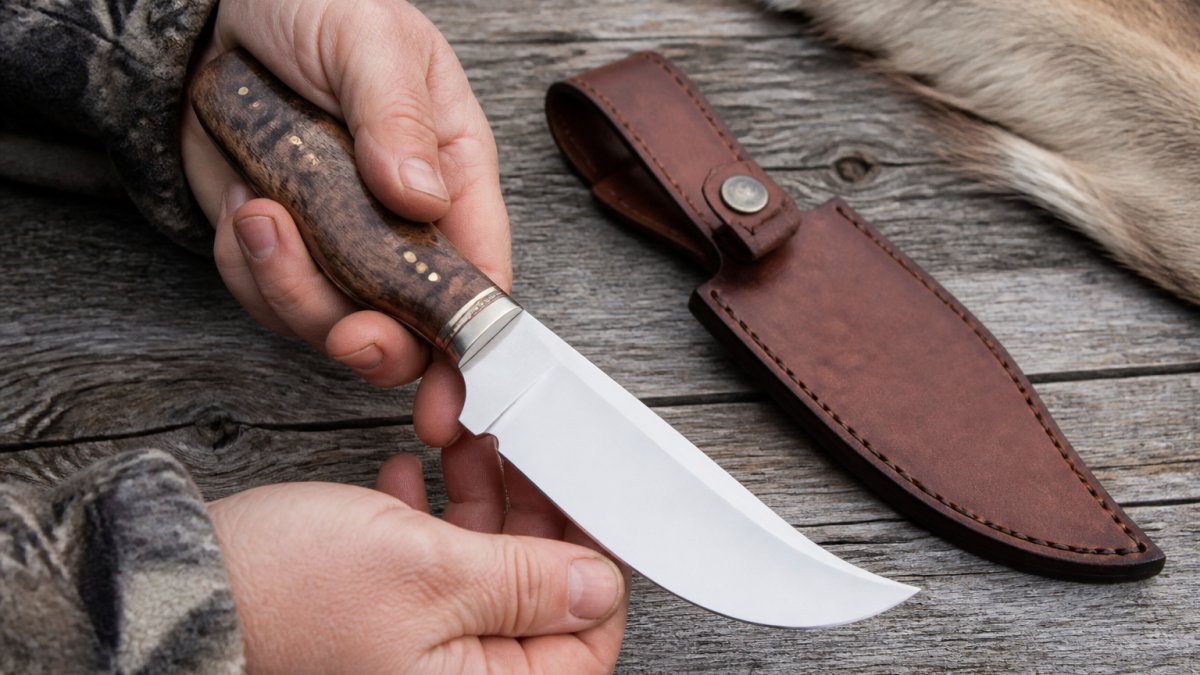
| Knife | Price | Best For |
|---|---|---|
| The Blister Beetle Skinner with Cryo | $115.00 | Larger hands, general skinning |
| The Hawk Wasp Skinner with Cryo | $125.00 | All-around field carry |
| The Badlands Skinner with mirror finish | $99.00 | Compact carry, RC 56-57 |
| Titanium Coated Fury Skinner | $115.00 | Drop-point durability |
| The Fat Boy Skinner | $99.00 | Cross-draw or hip carry |
The Badlands Skinner states its hardness outright at RC 56-57, the kind of number we wish every maker published. To see the full cryo build, shop the Blister Beetle Skinner with Cryo.

Choosing Your Hunting Knife: What to Ask Before You Buy
Ask four questions before you spend: what steel, what hardness, what grind, and what happens if it does not fit your hand. A maker who cannot answer the first two is guessing.
- Steel grade named, not just "stainless"
- Hardness stated in HRC
- Heat-treat process described, cryo or not
For the full walkthrough, our handcrafted hunting knife buying guide covers sizing, steel, and handle selection in detail. Our lifetime satisfaction guarantee exists because a knife that does not fit your hand is not a knife you will carry.
Frequently Asked Questions
Does cryo treatment improve a knife's edge retention?
It can, but not automatically. Cryo-treated steel may reach higher hardness and convert retained austenite to martensite, which supports edge holding. Montana Knife Company notes hunting knives typically run 60-62 HRC as a balance between edge holding and toughness. The catch is that heat treatment overall matters as much as the steel, so cryo is one variable among several. Ask a maker how the whole process is run, not just whether cryo is used.
Does cryo-treated steel make a hunting knife tougher?
Sometimes, but the relationship is not guaranteed. Knife Steel Nerds reports that cryogenic treatment can raise hardness with little change in toughness in some cases. Higher hardness usually means better wear resistance and a more brittle edge, so knife steel toughness is a trade-off you manage, not a switch you flip. For hunting, where blades meet bone and hide, a sensible hardness range and a sound heat treat matter more than cryo alone.
What are the downsides of cryogenic treatment for knife steel?
Cryo does not benefit every steel. Kizlyar Supreme notes it is most relevant when the hardening route leaves retained austenite or when testing shows a useful improvement. CTP Cryogenics describes cryo as an enhancement to conventional processing, not a standalone way to substantially increase hardness. It adds cost and process time, and without comparative testing you cannot assume a better field result. A harder edge can also be slower to sharpen if you let it dull badly.
Is cryo-treated steel harder to sharpen?
A harder edge takes more effort to reset but holds its geometry longer. If you maintain the edge with light touch-ups, cryo-treated steel at a sensible hardness stays workable. The bigger risk is letting a hard, thin edge chip or roll and then trying to grind it back in the field. Carry a small sharpener, touch up after each animal, and match the blade to the task. GS Custom Knives cryo blades like the Blister Beetle Skinner at $115 are built for that routine.
What is the best steel for a hunting knife?
There is no single answer, because the best steel for a hunting knife depends on the heat treat and the job. A stainless steel in the 60-62 HRC range balances edge holding and toughness for skinning and boning. Off Grid Knives recommends CPM MagnaCut for corrosion resistance, toughness, and edge retention, while Montana Knife Company stresses that heat treatment matters as much as steel choice. Pick a maker who can explain the process, then match blade shape and handle to your grip.
The real question is not whether cryo-treated steel is better in the abstract. It is whether the maker using it can name the steel, state the hardness, and stand behind the edge when it meets bone at dusk. That is the standard we build to at GS Custom Knives, with handcrafted blades, custom handle materials, and a lifetime satisfaction guarantee behind every order. Get started with GS Custom Knives and carry a hunting knife that was finished for the field, not the spec sheet.
